Why earthquakes, volcanic eruptions, and tsunamis cause one another
Calamities never come alone. Natural disasters can also cause other disasters. Today, we will explain how this happens and when to expect it.
Earthquake ➡️ Tsunami
Remember, the surface layer of our planet—the crust—is not solid like the shell of an egg. The crust is more like pieces of a vase glued together haphazardly, which are constantly moving and pressing against each other. These fragments are called tectonic plates.
Since the plates have been continuously subjected to pressure from the magma and mantle below them, for billions of years, they constantly collide with each other. In places where the once-closed edges of different plates can no longer withstand the pressure, suddenly jumping apart to move further, a powerful shock occurs—the epicenter of an earthquake.
On the ground, we experience this as a shaking movement of rocks. But it is not uncommon for the epicenter of an earthquake to be located under the ocean floor. Then the energy of the shock goes into the water, literally pushing a huge mass of water upward.
It’s as if someone threw a cobblestone into the water, but not on the surface, but from the center of the Earth. And instead of a cobblestone, a small mountain.

The 2011 Japanese earthquake is a striking example. After tremors measuring 9 on the Richter scale, a tsunami flooded entire cities, and caused a radiation accident at the Fukushima nuclear power plant. Photo: Kyodo News / AP / Scanpix / LETA
On the ocean’s surface, this leads to the formation of a wave that, as it approaches the shore and encounters increasingly shallow water, grows to a height of several meters or even tens of meters—a tsunami.
Tsunamis often (but not always!) occur after strong earthquakes at sea, and if seismographs detect tremors, data from marine buoys is connected, and if confirmed, the authorities immediately issue a warning. To save your life, it is best to take these warning messages as seriously as possible, and move to higher ground.
Earthquake ↔️ Eruption
An earthquake can also cause a volcanic eruption. But not just any volcano, and not every time.
Volcanoes appear in the familiar form of a cone protruding from the Earth’s surface, where cracks and other irregularities in the crust allow magma—a molten mixture of rock and gases—to penetrate closer to the surface.
When an earthquake occurs nearby, the pressure in the rocks around the volcano changes. Fissures—channels for magma to escape—may appear or expand. The magma immediately seeks to occupy new areas, and a breakthrough to the surface—an eruption—becomes possible.
But for an earthquake to have such an impact, it must be strong enough (magnitude above 6), the epicenter must be within at least 100 kilometers of the volcano, and there must already be enough magma accumulated under the volcano itself.
In early August 2025, all these conditions came together in an earthquake in Kamchatka, in the far east of Russia (west of Alaska). Then, an earthquake with a magnitude of 8.8 was followed by the eruption of six (!) nearby volcanoes, including the first known eruption of the Krasheninnikov Volcano in 600 years.
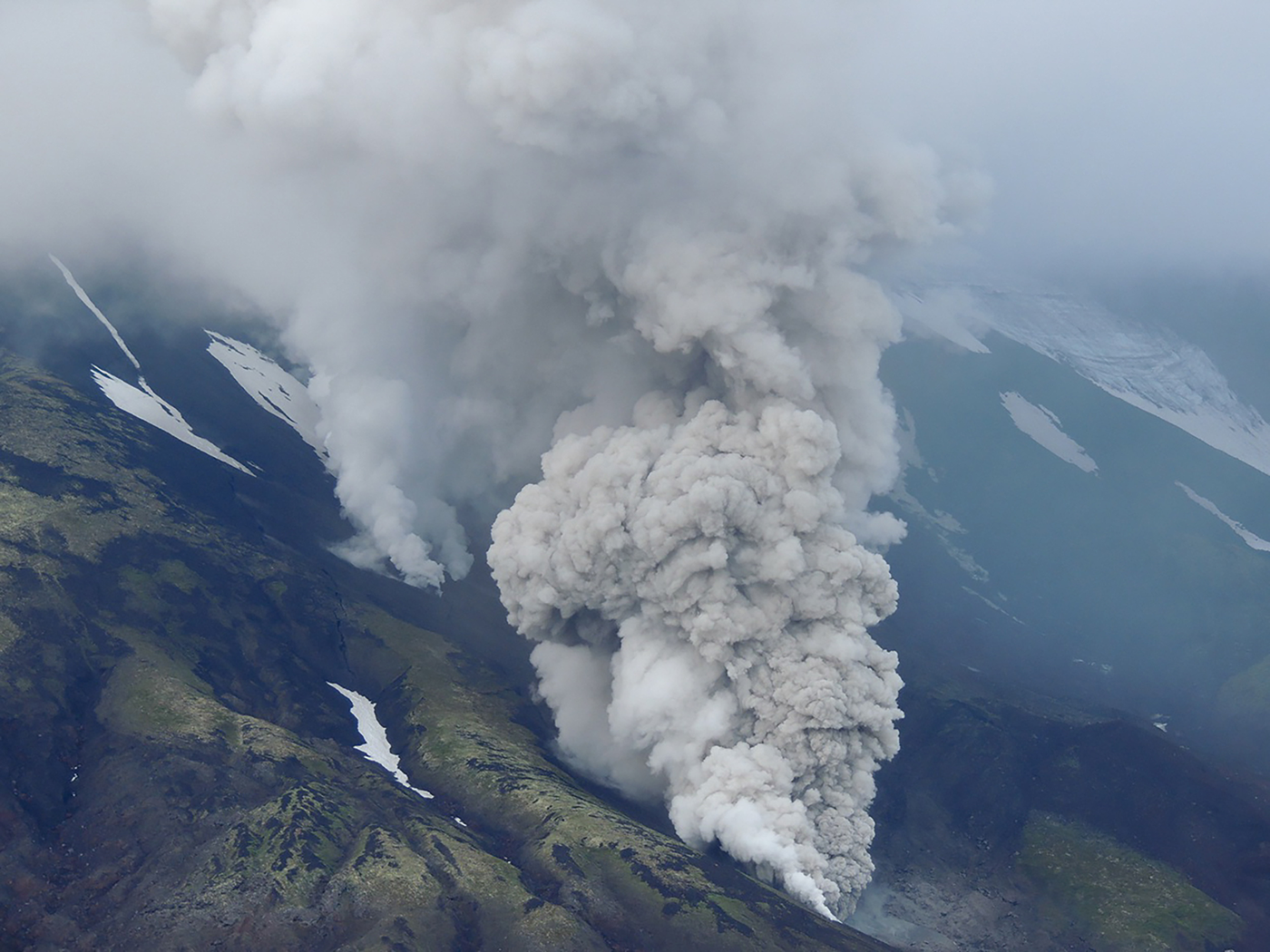
Eruption of Krasheninnikov volcano, apparently caused by an earthquake in Kamchatka. Photo: Natalia Akbirova/TASS
This same earthquake should have caused a huge tsunami, potentially threatening the inhabitants of Japan, Russia, and even the United States (Hawaii). But due to the fortunate location of the epicenter and other factors, a destructive tsunami did not occur. Geologists agreed that people were very lucky.
If you noticed the arrow in the subheading above, you may have guessed that the opposite situation is also possible—an eruption can cause an earthquake. But this is very rare. The magma eruption itself causes a series of tremors, which are usually relatively weak, and it is impossible to say with certainty that strong earthquakes are directly caused by volcanoes.
Eruption ➡️ Tsunami
Volcanoes generate tsunamis much less frequently than earthquakes, in different ways.
The eruption of magma from an underwater volcano can push water upward, as earthquakes do. But powerful tsunamis occur when an eruption causes the wall of a volcano to collapse, and thousands of tons of rock fall sharply into the sea, causing a large wave.
This is what happened, for example, during the powerful eruption of the Indonesian volcano Krakatoa in 1883. The collapse of the island caused a tsunami up to 40 meters high, which, according to local authorities, claimed the lives of up to 32,000 people (approximately 90% of all victims of the eruption).
And in 1888, the collapse of a volcano on Ritter Island in Papua New Guinea led to a wave up to 15 meters high. It is believed that this eruption could have been caused, at least in part, by tectonic processes and not just by magma pressure.
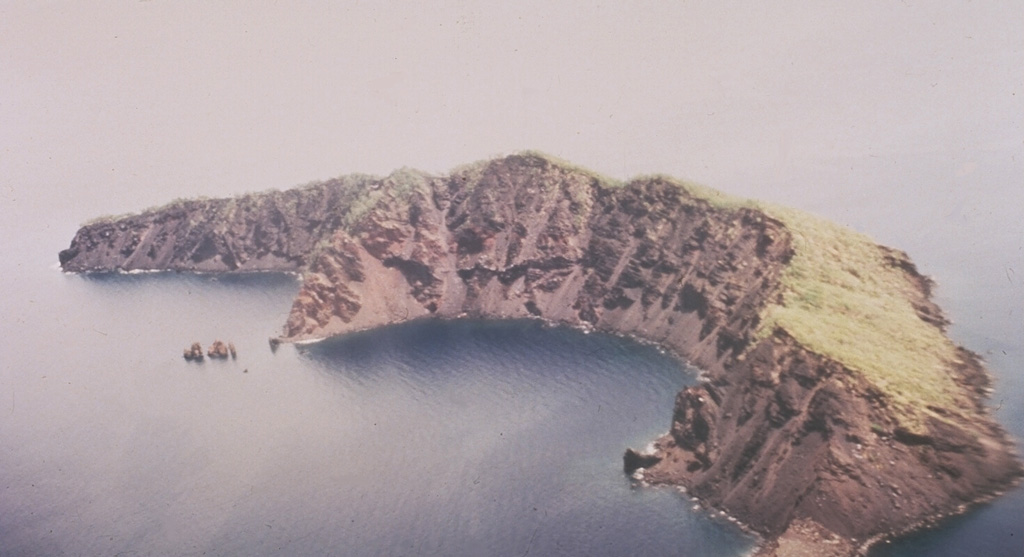
All that remains of Ritter Island after the eruption. The height of the island after the collapse of the western wall of the volcano decreased from 720 meters to just 140 meters. Photo: Hugh Davies/University of Papua New Guinea
It is important to note that the relationship between tsunamis, earthquakes, and eruptions is mostly observed in a specific region—the Ring of Fire, along the edges of the Pacific Ocean. This is where the edges of different tectonic plates converge, which is why up to 90% of all earthquakes can be found there. Up to 75% of the planet’s active volcanoes are also located around the Ring of Fire.
The ring runs along the eastern coast of Eurasia (the Pacific coast of Russia, Japan, and Indonesia) and the western coast of the Americas (Chile, Peru, the Pacific coast of the United States, Mexico, and Canada).
If you live elsewhere, the danger is lower. If you live on the Ring, there is no need to live in constant fear—truly destructive disasters are rare. You should simply pay close attention to warnings from the authorities, which will only become more accurate and timely thanks to the growth in the number of stations and tracking methods.
Text: Jason Bright, a journalist and a traveller.
Cover photo: Yosh Ginsu / Unsplash
Read more:
How weather changes the topography
Squalls: How to predict them, recognize them, and take cover


Latest News
Professional Weather App
Get a detailed online 10 day weather forecast, live worldwide wind map and local weather reports from the most accurate weather models.
Compare spot conditions, ask locals in the app chat, discover meteo lessons, and share your experience in our Windy.app Community.
Be sure with Windy.app.