Share:


Imagine a sea with no shores. And an island in the middle of this sea that you can’t even stand on. Can’t picture it? Then let us help: meet the Sargasso Sea — the most unusual sea in the world.
We usually think of a sea as a body of water separated from the ocean by the shores of continents or islands. For example, the Mediterranean Sea lies between Europe and Africa, and is only connected to the ocean by the Strait of Gibraltar. The Philippine Sea, separated from the Pacific Ocean and other seas by island chains, can be considered more «open.»
But the Sargasso Sea has no borders at all. Located in the Atlantic Ocean off the east coast of the United States, its boundaries are formed not by land, but instead by ocean currents: the Gulf Stream, the North Atlantic, the Canary, and the North Equatorial.
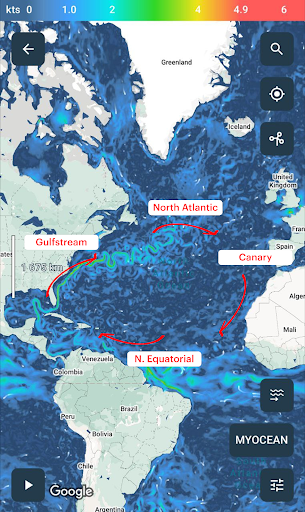
The four currents that form the Sargasso Sea. The Gulf Stream and North Atlantic Current are the most visible on the online map, but you can try spotting them all!
Why call this a «sea» at all? Because currents, like coastlines, restrict the free exchange of water between the sea and the ocean. Inside this giant rotating system, a closed environment forms—with its own water characteristics and unique wildlife. In other words, much the same happens here as in other ordinary seas.

Sargassum seaweed beds, which the sea is named after. These «sea meadows» can stretch for many kilometers, and can even slow down ships. Source: Ocean Explorer/NOAA.
Ocean currents are constantly shifting, so the boundaries of the Sargasso Sea are moving as well. The sea doesn’t drift far from its usual position, but it expands and contracts slightly in different directions.
And here’s another surprise: the Sargasso Sea is the largest sea on the planet. It is only slightly smaller than Australia. If it were a country, it would rank among the seven largest in the world.
Think a floating sea is strange? That’s just the start. The Sargasso Sea is also convex! The surrounding currents swirl inward, piling water toward the center. As a result, the water level in the middle of the sea is 1–2 meters higher than at its edges.
And yes — the famous Bermuda Triangle lies within the Sargasso Sea. We’ve already written about the most scientific explanation for its mysteries: methane bubbles.
Most scientists, however, believe the «mystery» of the Bermuda Triangle doesn’t exist at all. The area simply has heavy shipping and air traffic. Looking at percentages instead of raw numbers, the rate of lost ships here is no higher than anywhere else. Although, of course, the government of Atlantis would like us to think otherwise!
So no, the Bermuda Triangle isn’t the Sargasso Sea’s biggest problem. But it does face other serious ones.
There are five so-called «garbage patches» in the world’s oceans. These are zones where winds and currents collect floating waste from vast areas. With no way out, trash piles up for years, creating massive ocean dumps. Garbage patches typically form in the central parts of oceans — and one of them lies inside the Sargasso Sea, carried there by the very currents that define it.
The trash includes everything: from old fishing nets and discarded packaging, to household appliances swept into the ocean during floods. But the majority is microplastics—fragments less than 5 mm across.
Under the intense sunlight of the open ocean, plastic breaks into ever smaller pieces. They can become so tiny that the water appears clean, while in reality, it’s full of particles. Microplastics are especially dangerous: they are easily ingested by marine animals, accumulate in their bodies, and often lead to their death. Almost everyone who eats seafood is already consuming small amounts of microplastics in every bite.
Various projects aim to clean up ocean garbage patches, often using ships equipped with filtration systems. But for now, the scale of removal is still tiny, if compared to the amount of plastic entering the seas—just a drop in the ocean.
Cover photo: Thor Tryggvason / Unsplash