The Life of a Cyclone, Part One
Cyclones are the main inhabitants of the weather world. They are born and grow, make friends and part ways, reach their peak, and eventually grow old. Each one has its own character and unique path. We will talk about the unusual life of an ordinary cyclone — not a tropical one, but a cyclone from the temperate latitudes. These are rarely as powerful, yet they can spoil the weather for outdoor enthusiasts across vast territories for many days.
Infancy
The birth of a new cyclone is a true mystery. We understand this process fairly well, yet it is so complex that no single theory can fully describe it. Still, two essential conditions are always mentioned — though often phrased differently:
- Temperature contrast — when warm and cold air masses are in close proximity. This is the brain of the cyclone: without contrast, it cannot exist.
- Rising air — this is the heart of the cyclone. It takes only a slight trigger — surface heating or topographic lift — for the air to begin rising, and the heart to start beating.
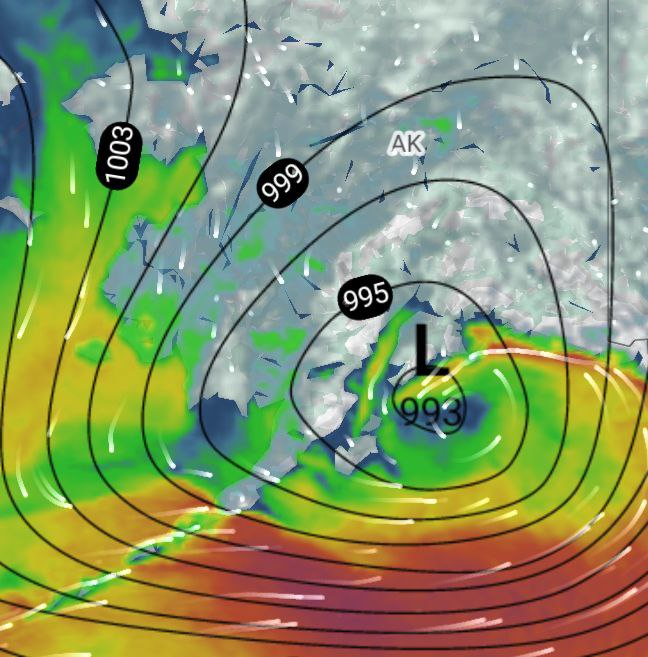
Cyclones are best seen on weather maps in the form of isobars, lines of equal pressure. Air pressure is lower in the center (because the air is rising) and higher along the edges. The center is usually marked with the letter L, for «low pressure.»
As air rises in the center, air from the periphery flows in to replace it—like blood rushing to the heart. Due to the Coriolis effect, the air begins to swirl: counterclockwise in the Northern Hemisphere, and clockwise in the Southern Hemisphere.
At this moment, a cyclone is officially born.
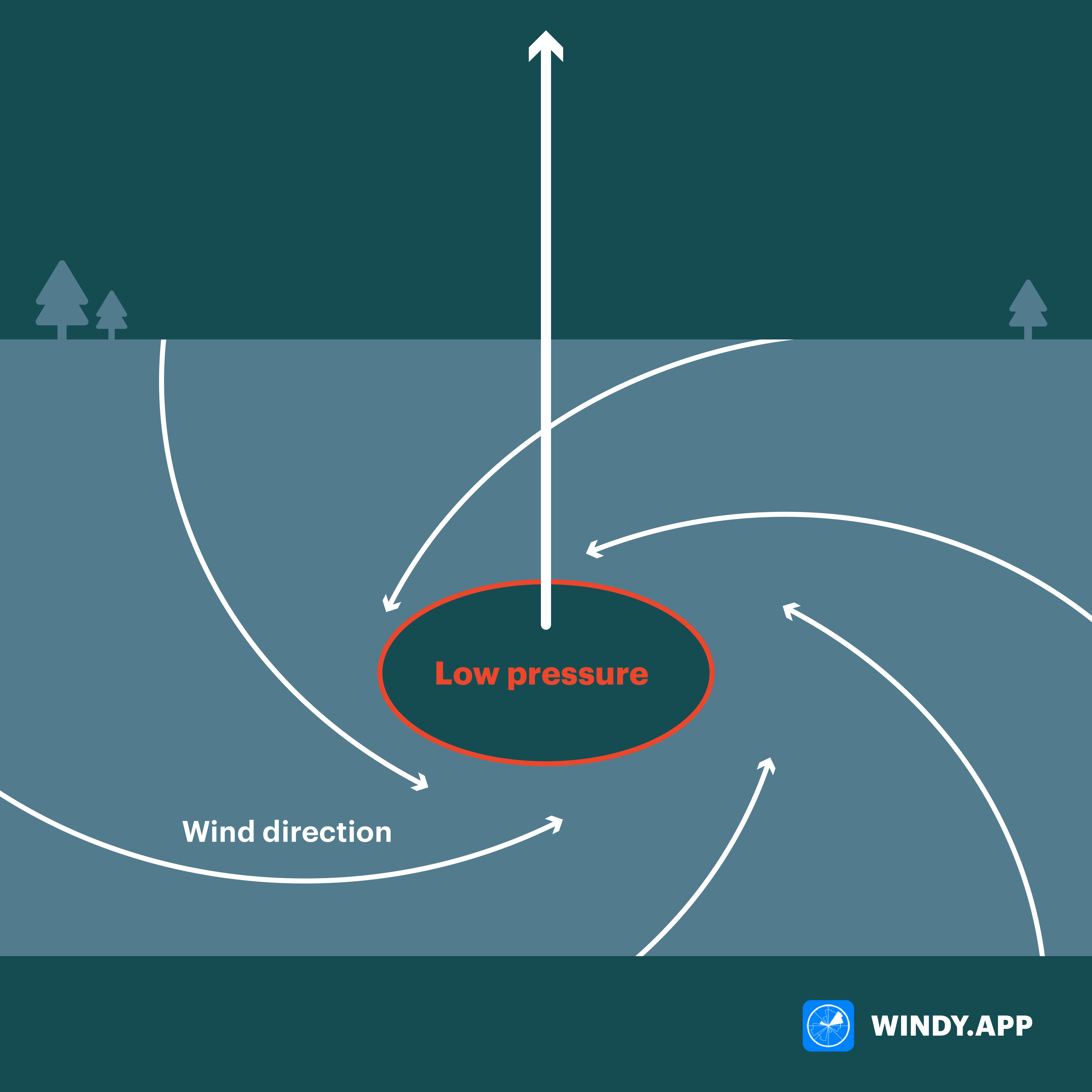
In a cyclone, the wind not only spirals toward the center but also rotates around it — and at the very core, it rises upward. Illustration: Valeria Milovanova / Windy.app
Cyclones Maternity Hospital
Most cyclones form in specific, favorable regions—places where warm seas meet cold lands, or where the terrain creates strong temperature contrasts.
One of the most famous «maternity wards» is the North Atlantic Ocean, often called the «cyclone factory.» Here, the warm Gulf Stream encounters the cold shores of Canada and Greenland, creating ideal conditions for cyclone formation.
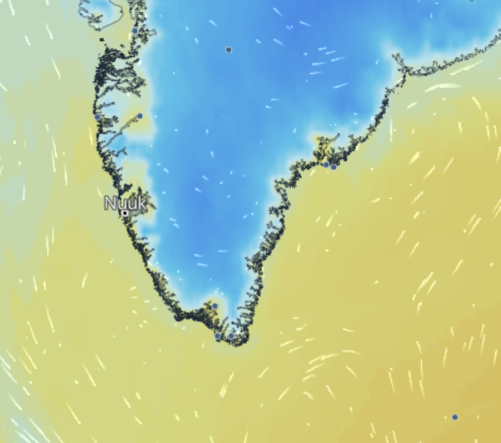
Cold Greenland (blue) and the warm ocean (yellow)—the perfect combination for cyclogenesis.
However, new cyclones can also be «born» from older ones—and in the Southern Hemisphere, this is almost always the case. How cute!
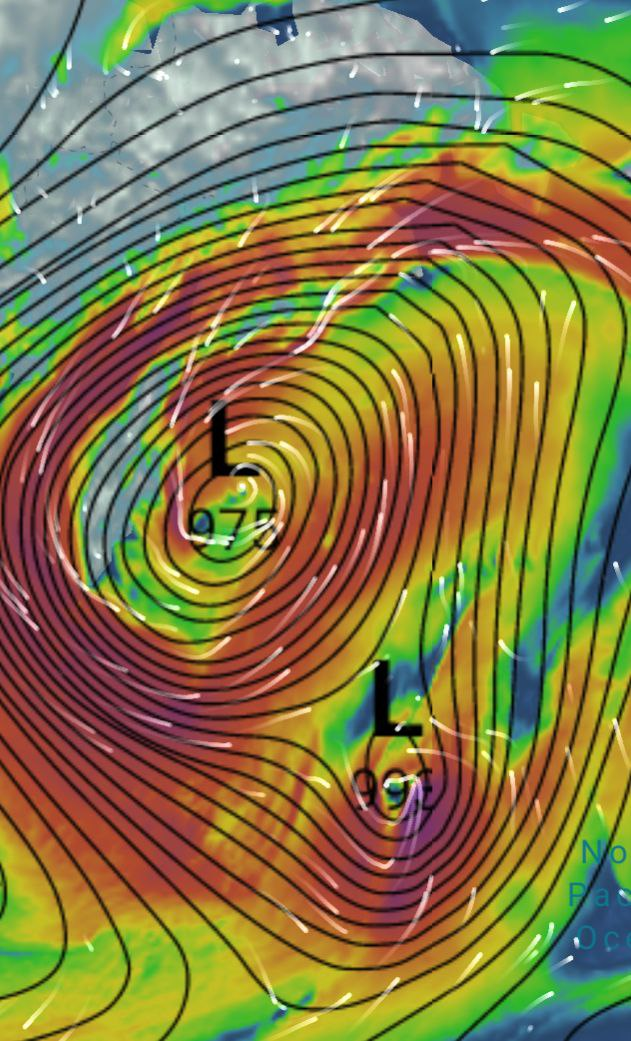
A small cyclone (lowercase l) is born from a large one (uppercase L).
This happens when, as a cyclone matures, the wind in certain parts begins to blow in an opposite direction to the general circulation. These areas are called waves, and it is from such «waves» that new cyclones develop.
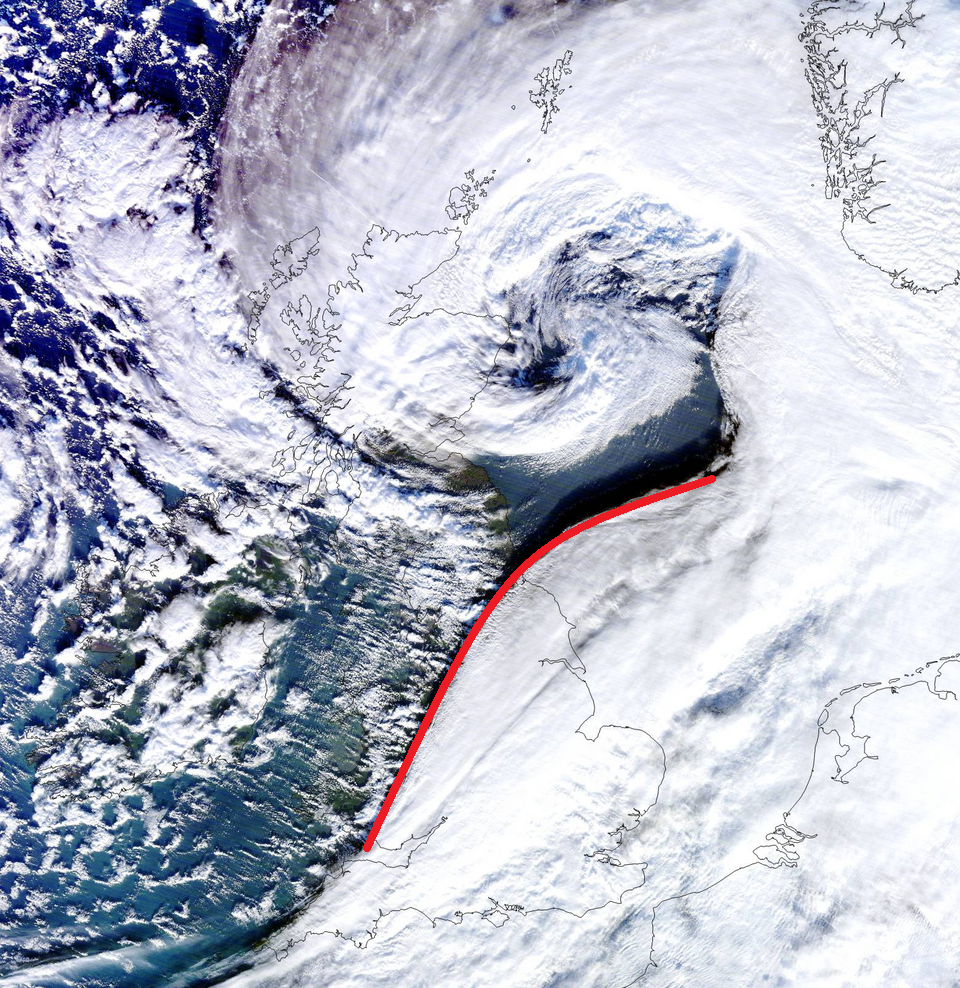
Satellite image of an old cyclone. The hump-like wave, from which a new cyclone will soon emerge, is marked in red. Source: Nasa / Wikimedia
When a cyclone has rising air in its center, temperature contrasts between warm and cold air masses, and rotation, it can be considered fully formed.
Let’s now leave our young cyclone for a while to gather strength. In the next part, we will return to the fascinating story of these ordinary yet extraordinary weather beings—and find out what happens to them as they mature.
Text: Eugenio Monti, a meteorologist and a climatologist
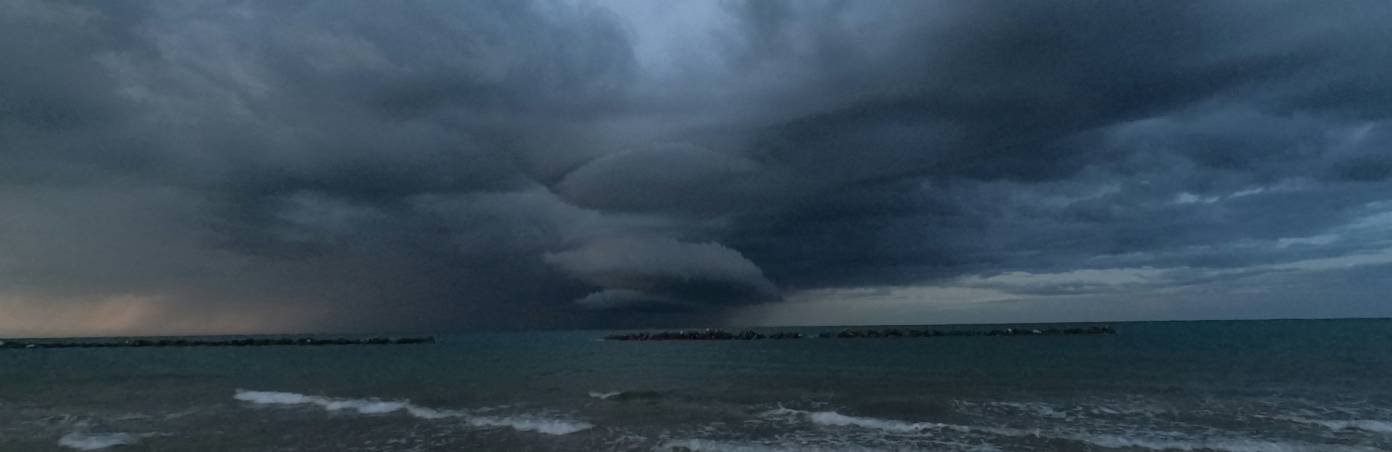
Cover photo: Carlo / Unsplash
Read more:
Why Do People See Dementors in the Sky?


Latest News
Professional Weather App
Get a detailed online 10 day weather forecast, live worldwide wind map and local weather reports from the most accurate weather models.
Compare spot conditions, ask locals in the app chat, discover meteo lessons, and share your experience in our Windy.app Community.
Be sure with Windy.app.