How do weather models work
As recently as 70 years ago, weather forecasts were based solely on weather charts. These forecasts were not particularly precise, as only slightly over half of the predictions came true. But weather models were an absolute breakthrough, and over 95% of modern forecasts for the next 24 hours are accurate. Today, we will tell you what is behind the models, how they work, and how they differ.
Numerical weather prediction
Weather models are based on one fundamental idea: the atmosphere can be described through physical equations. These equations are solvable, meaning it is possible to find one variable if you know the others. Solving this type of equation is called numerical weather prediction.
It might sound mind-blowing, but all processes regarding air are described with just five equations. They are called «primitive», although not in the sense of being simple, but rather because they are initial, basic, and primary compared to all of the rest. Primitive equations contain:
- Properties of air as matter
- The laws of air movement
- The law of conservation of matter (if something disappears from somewhere, it appears somewhere else)
- The law of heat conduction describing how air heats up and cools down
- The law describing how atmospheric properties change with altitude
There are other important equations, of course. They describe processes only indirectly related to air, which nevertheless influence the main weather elements, such as cloud formation and precipitation, solar radiation, and underlying surfaces.
What do we get by solving these equations?
Thanks to observation data, we know the weather conditions at the present moment. And by knowing the laws that rule the atmosphere, we can find out what these conditions will be like in the future. That’s a weather forecast. But it’s not all that simple.
Let’s imagine the simplest equation: Y = X + 1. If we know the value of X, we can always find Y. This is referred to as solving the equation analytically. However, our equations are much more complex, and cannot be solved in the same way. We can only find their solution approximately, with a degree of uncertainty.
What does the degree of uncertainty depend on?
First of all, it depends on the presence of observation data. Weather stations are the main source of data that «feeds» the models. There are traditional stations where all measurements are taken manually, and automatic stations. The latter are less precise, but take little space and don´t need salaries and days off! Nowadays, long-distance observation solutions, such as weather satellites and radar, are becoming more and more common. There is a lot of data, but it is still not enough. The biggest missing piece is data from above the oceans, where only remote sensing is possible. And the oceans, as you know, play a crucial role in influencing weather worldwide.
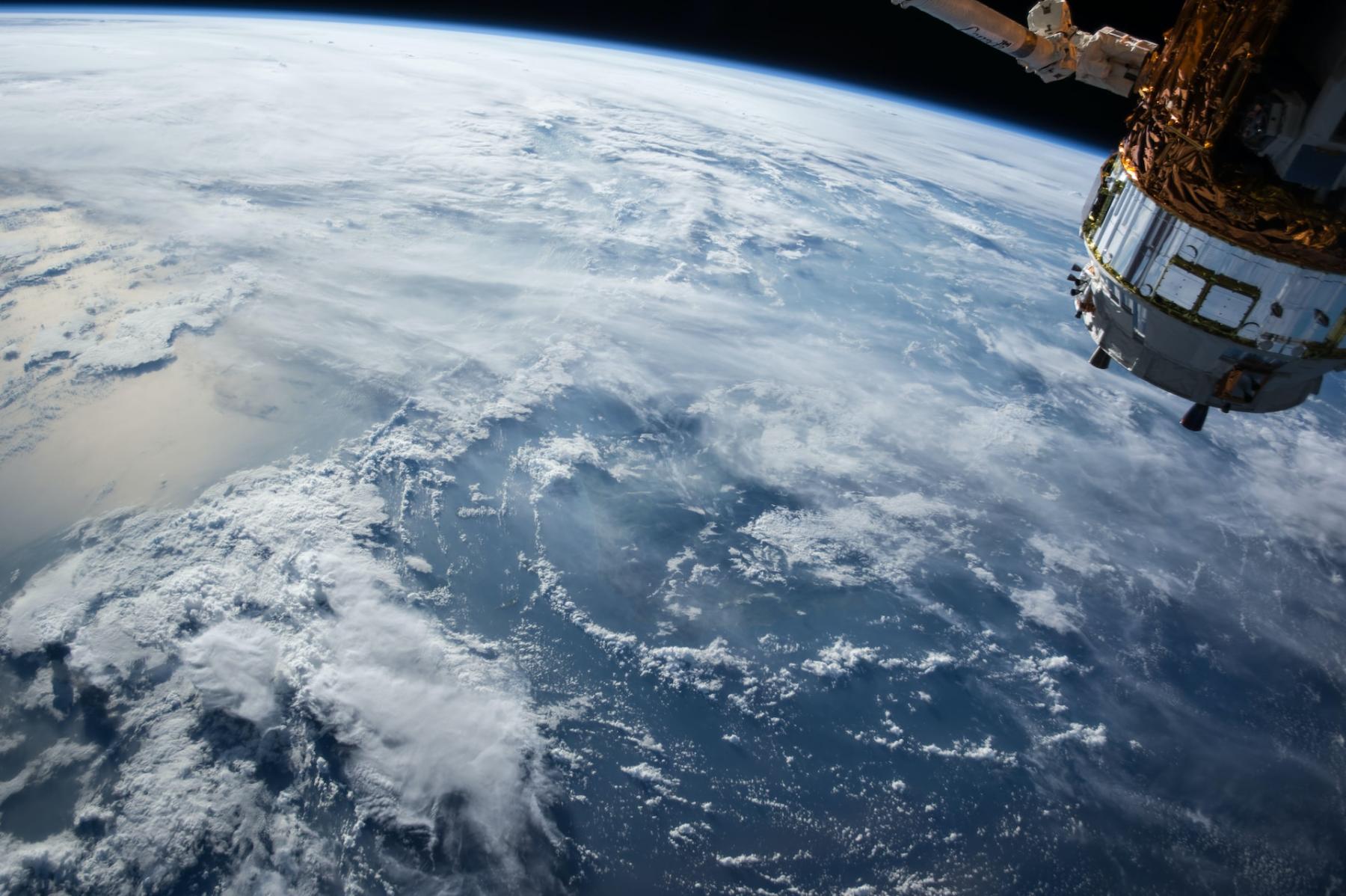
Satellites can take measurements from above any territory, but their precision capabilities are still limited. Photo: NASA / Unsphash
Overall, the more precise we want the forecast to be, the more data we need. But there is a problem: to describe all the processes in the atmosphere, we need to take data from every centimetre of the Earth’s surface. And all the way up through the atmosphere!
But even if it were physically possible to install so many weather stations, it wouldn’t help. There is a lot of data, and the formulas are very complex. Even the most powerful computers in the world make these calculations pretty slowly. And the more information we put in, the longer it takes to get a result. Imagine if you wanted to make a forecast for 1 hour ahead, and the calculation of this forecast would take 2 hours. It just doesn’t make any sense!
So, is everything bad then?
No, it isn’t. Scientists came up with many «simplifications» that allow to compensate for the lack of data and computer-capacity limitations. Well, we call them simplifications, but in reality, they make things even more complex. The number of formulas grows, but they become tailored to our data, our computers, and our goals. A system of equations for synoptic processes is a good example of this type of simplification. It will have cyclones and anticyclones, but convection will be completely neglected. This allows us to speed up the calculations many times.
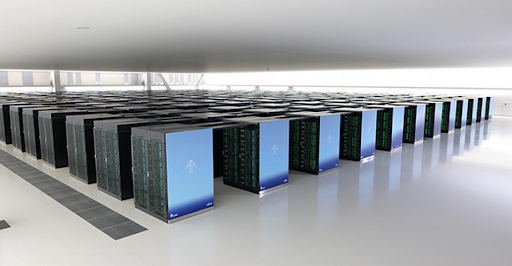
This is what computers that run weather models look like. They occupy entire buildings!
Parametrisations are developed to ensure that these models don’t lose much quality. They are simplified descriptions of the processes that are not included in the model. Parameterizing physical processes for models is a vast area of scientific research. High-quality parameterizations are one of the keys to the success of any model. The calculation capacities of the computer freed by parametrization can be used to improve any other characteristic of the model.
How are weather models different from one another?
Weather models are not all the same. We have already written a few articles where we compare the models used in our app in great detail. Here, we are going to put it more simply.
Large international organisations own the most powerful computers. One of the biggest calculation centres in the world is the European Centre for Medium-Range Weather Forecasts (ECMWF), which brings together over 30 countries from Europe and Asia. Many people consider the model developed by the ECMWF to be the best in the world.
You can use the calculation capacities of a computer in different ways. You can improve the «physical base» of the model, reducing the number of processes that need to be parameterized. You can reduce the distance between spots for which we are making a forecast (that is, increase the spatial resolution) or reduce the time steps. For instance, a global model called ICON has a spatial resolution of 13 km, and that’s not bad at all. However, its version for Central Europe has a resolution of 2.2 km, which is 6 times better. All that is because the calculation is performed for a much smaller territory, and the freed-up calculation capacities of the computer were switched to increasing spatial resolution.
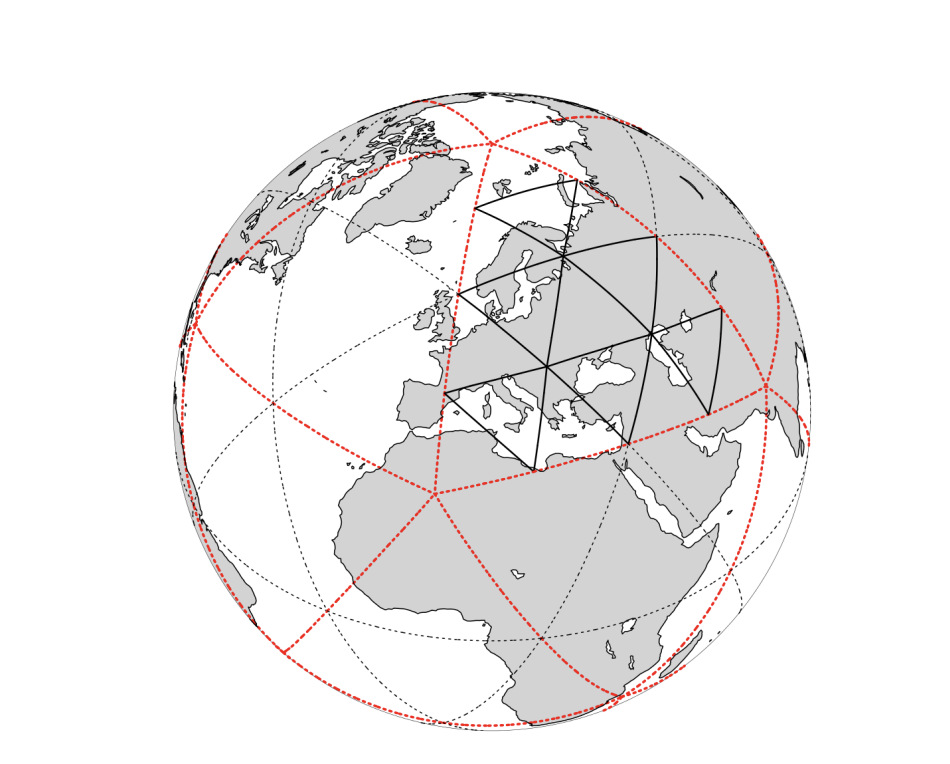
Scheme of space resolution of the ICON model. The model calculates values for the crossing points of the lines.
Developing cloud-based technologies also allows for recalculating data from the existing models in better resolution. For example, for our app, we recalculate the forecast with a resolution of 8 km for Europe, and 3 km for East Asia, based on the WRF model on our own computers.
Are there any issues with numerical weather prediction?
The accuracy of numerical predictions is steadily increasing. More powerful computers appear, the observation network grows, and parameterizations are improving. But we can’t trust weather models blindly. Small errors (at the model scale) can dramatically affect your day. For example, a rain cloud can end up right over you when it was supposed to pass by, or a predicted heavy rain can start a couple of hours earlier. To get the most complete and precise weather forecast, we recommend comparing forecasts from different models available in your region, and complementing them with weather maps and data from weather radar.
But in spite of all these limitations, the present and the future of weather prediction will be driven by numerical methods.
Text: Eugenio Monti, a meteorologist and a climatologist
Cover photo: Rach Sam / Unsplash
Read more:
How to read wind barbs — wind speed and direction symbols
How to read hurricane map like an expert


Latest News
Professional Weather App
Get a detailed online 10 day weather forecast, live worldwide wind map and local weather reports from the most accurate weather models.
Compare spot conditions, ask locals in the app chat, discover meteo lessons, and share your experience in our Windy.app Community.
Be sure with Windy.app.